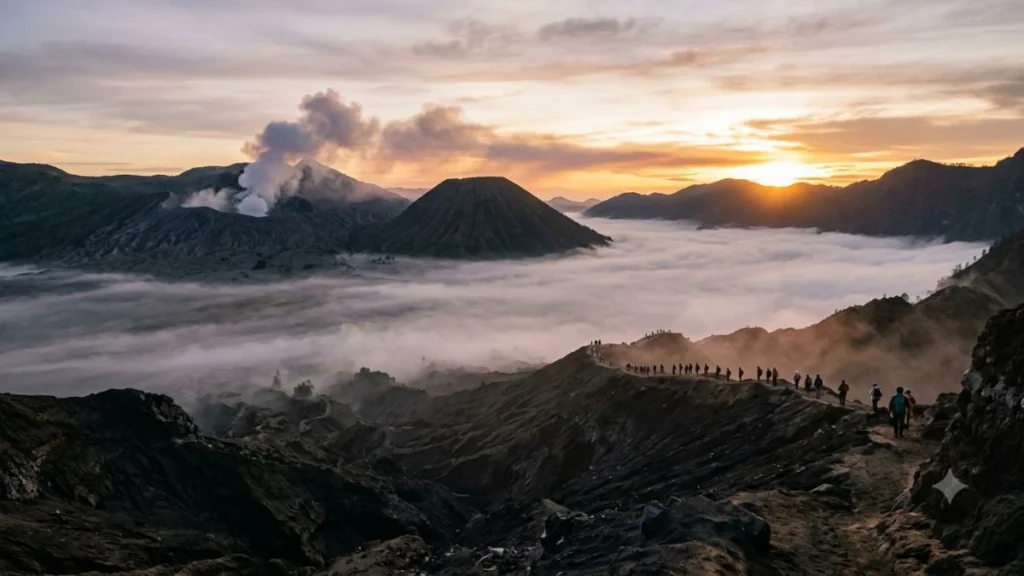
At dawn, on a specific night determined by an ancient lunar calendar, thousands of people descend into the crater of an active volcano and throw offerings — rice, vegetables, livestock, even money — directly into its smoking mouth. Some of the offerings are then caught by others waiting below with nets, in a practice that looks, to an outsider, almost recklessly casual around genuine volcanic danger. This is the Kasada festival, one of Indonesia’s most distinctive and least-known living traditions, observed by the Tenggerese people of East Java around Mount Bromo.
The Ritual Itself
Kasada (also called Yadnya Kasada) takes place annually on the fourteenth day of Kasada, the twelfth month of the Tenggerese calendar, typically falling sometime between June and August depending on the lunar cycle. The Tenggerese community — a distinct ethnic group who practice a form of Hinduism shaped significantly by older Javanese and animist tradition, unlike the Muslim-majority population of most of East Java — gather at the edge of Mount Bromo’s crater, an active volcano, after a ceremonial procession from the village temple.
At the heart of the ritual, offerings of produce, livestock, and household goods are thrown directly into the crater as a gesture of gratitude and appeasement toward Sang Hyang Widhi Wasa, the Tenggerese Hindu concept of a supreme divine force, and toward the mountain itself as a site of spiritual power. Some local residents position themselves along the crater’s slopes with nets specifically to catch offerings tossed by others, a practice understood partly as an act of blessing-sharing rather than simple opportunism, though its exact social meaning has shifted somewhat as the festival has drawn wider public attention.
Where It Comes From
Kasada’s origin traces to a legend central to Tenggerese identity: the story of Roro Anteng and Joko Seger, a princess and a young man believed to be the ancestral founders of the Tenggerese people, who prayed to the gods for children after years without success. Their prayer was granted on the condition that their youngest child eventually be sacrificed to Mount Bromo. When the time came, their youngest son, Kesuma, was said to have been swallowed by the volcano, but his spirit spoke from within the crater, instructing the Tenggerese people to hold an annual offering ceremony in his memory and in gratitude to the mountain — the origin point of the Kasada tradition still observed today.
This foundational legend positions Mount Bromo not merely as a natural landmark but as an active, still-engaged spiritual presence within Tenggerese cosmology, explaining why the ritual continues to be treated with such consistent seriousness despite the very real physical danger an active volcano represents.
Modern Practice
Kasada remains a genuinely living tradition, actively practiced by Tenggerese communities across villages surrounding Mount Bromo, rather than a ceremonial revival staged primarily for outside audiences. That said, the festival has increasingly become a significant tourism draw, with visitors from across Indonesia and internationally traveling to witness the predawn procession and crater offerings, a dynamic that has introduced both economic benefit to local communities and quiet tension around how much the ritual’s original spiritual seriousness can coexist comfortably with growing spectator crowds and photography-driven tourism.
Local and national authorities also maintain close monitoring of Mount Bromo’s volcanic activity around the festival dates, given the very real ongoing risk — the mountain remains an active volcano with a documented history of eruptions, meaning the ritual’s timing and safety protocols require genuine, non-symbolic caution alongside its ceremonial significance.
What Outsiders Often Get Wrong
Casual visitors sometimes treat Kasada primarily as a striking photo opportunity or adventure tourism spectacle, missing the ritual’s deep, actively lived spiritual significance to the Tenggerese community specifically, distinct from the broader Javanese cultural traditions more commonly covered in general Indonesia travel content.
There’s also a common misconception that Kasada is a broadly Javanese or generally Hindu-Indonesian tradition, when it’s specifically and distinctly Tenggerese, tied to this particular community’s unique ancestral legend and religious identity, separate from Bali’s more widely known Hindu traditions like Nyepi, despite some surface-level religious overlap.
FAQ
Is the Kasada festival dangerous to attend?
Mount Bromo remains an active volcano, and authorities monitor conditions closely around the festival. Visitors should follow official safety guidance and local authority updates regarding volcanic activity status before attending.
Who practices the Kasada festival?
The Tenggerese people, a distinct ethnic community living around Mount Bromo in East Java who practice a form of Hinduism shaped by older Javanese and animist tradition, separate from Java’s Muslim-majority population.
What kinds of offerings are thrown into the crater?
Offerings typically include rice, vegetables, flowers, livestock, and sometimes money, tossed into the crater as gestures of gratitude and spiritual appeasement.
Why do some people catch the offerings with nets?
This practice is understood partly as a form of blessing-sharing among community members and visitors, though its exact social meaning has evolved somewhat as the festival has grown in public visibility.
Is Kasada connected to Bali’s Hindu traditions?
There’s shared religious lineage through Hinduism broadly, but Kasada is specifically Tenggerese, rooted in a distinct ancestral legend and community identity separate from Balinese Hindu practice.