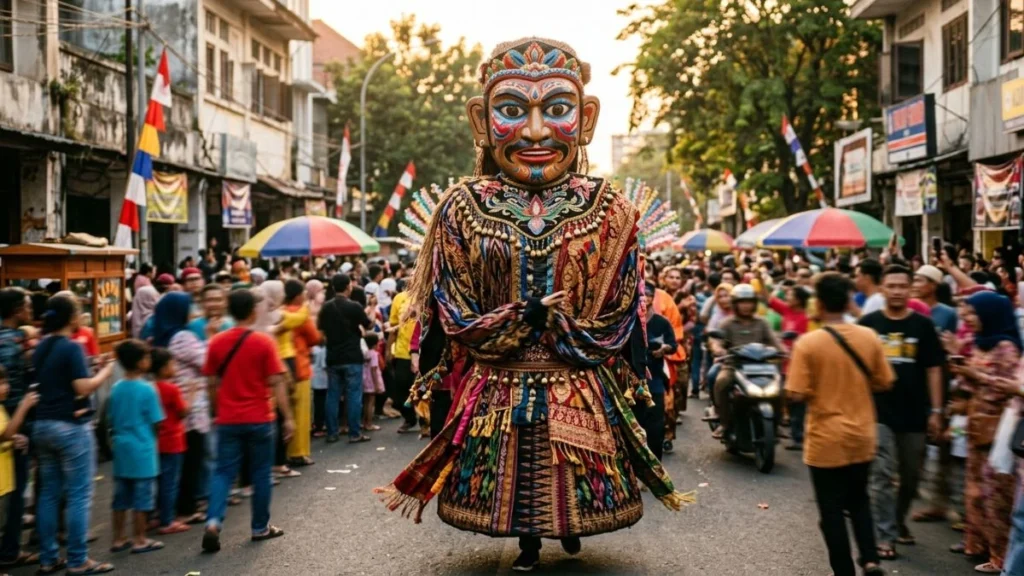
Walk through certain neighborhoods in Jakarta during a local celebration and you might come face to face with a towering figure nearly three meters tall, its oversized painted face fixed in an expression somewhere between fierce and comically exaggerated, moving with a swaying, deliberate gait to the sound of drums and gongs. This is ondel-ondel, the giant traditional puppet of the Betawi people — Jakarta’s original ethnic community — and its purpose was never purely decorative.
What It Is
Ondel-ondel are enormous puppet figures, typically standing nine to ten feet tall, constructed from a bamboo woven frame worn and operated by a performer walking inside the structure, similar in basic engineering to giant parade figures found elsewhere in the world but distinctly Betawi in aesthetic and purpose. They’re traditionally made in pairs — one figure with a red or masculine-painted face representing a male spirit, and one with a white or more delicate face representing a female spirit — and are almost always accompanied by traditional Betawi music, particularly the ensemble style known as tanjidor or gambang kromong.
The oversized, somewhat fearsome facial features aren’t accidental artistic choices. They’re functional, tied directly to the figures’ original protective purpose.
Where It Comes From
Ondel-ondel’s origins trace back centuries within Betawi culture, rooted in animist belief systems that predate and later blended with the Islamic influence that shaped much of Jakarta’s Betawi community — a syncretic layering not unlike the blending seen in Javanese traditions such as slametan, where older spiritual frameworks persisted quietly beneath a newer religious identity rather than being fully replaced by it.
Traditionally, ondel-ondel were understood as guardian spirits, their exaggerated, sometimes intimidating faces specifically designed to frighten away malevolent spirits (bala) that might otherwise threaten a village, event, or family celebration. The puppets were paraded through communities during significant occasions — circumcision ceremonies, weddings, or moments believed to carry particular spiritual vulnerability — functioning as protective figures rather than simple entertainment.
How It’s Used Today
Modern ondel-ondel has shifted substantially from its original protective, ceremonial role toward broader cultural celebration and, increasingly, informal street performance. The figures remain a fixture at official Jakarta cultural events, notably the city’s anniversary celebrations, where they’re paraded prominently as a proud symbol of Betawi heritage and Jakarta’s own distinct identity, separate from the many other regional cultures that make up modern Indonesia.
At the same time, a more informal and, to some, more concerning trend has emerged: ondel-ondel performers wandering residential streets and busy intersections seeking cash donations from passersby, sometimes with recorded rather than live music and noticeably less ceremonial care than the tradition’s original context called for. This practice has drawn genuine debate within Betawi communities and Jakarta’s cultural preservation circles, not unlike the quiet generational tension explored in the piece on jam karet, where a tradition’s outer form persists even as its deeper meaning and context visibly thins for a portion of those still performing or encountering it.
What Outsiders Often Get Wrong
Visitors and even many non-Betawi Jakartans frequently assume ondel-ondel is simply a fun, colorful cultural mascot without registering its original protective, spiritually significant purpose — closer, in intent if not form, to the guardian function some communities attribute to figures like Nyi Roro Kidul along Java’s southern coast, where respect for an older spiritual framework persists beneath modern casual encounters with the tradition.
There’s also a common misconception that the street-performance version represents ondel-ondel’s authentic traditional form, when in fact this practice is a relatively recent, informal adaptation, distinct from the more ceremonially significant use of the figures at formal cultural events and traditional celebrations.
FAQ
Why do ondel-ondel figures have such large, exaggerated faces?
The oversized, sometimes fierce features were traditionally designed to frighten away malevolent spirits, serving a protective rather than purely decorative function in the puppets’ original ceremonial use.
Are ondel-ondel male and female figures different?
Yes, they’re traditionally made in pairs — one with a red or darker “masculine” face and one with a white or lighter “feminine” face — together representing paired guardian spirits.
Is the street-performance version of ondel-ondel considered authentic?
It’s a more recent, informal adaptation rather than the tradition’s original ceremonial form, and has drawn debate within Betawi cultural circles about its departure from the practice’s deeper original meaning.
When are ondel-ondel traditionally used?
Historically, they appeared at significant community occasions such as circumcision ceremonies and weddings, believed to carry particular spiritual vulnerability requiring protective presence.
Is ondel-ondel specific to Jakarta?
Yes, it’s a distinctly Betawi tradition, tied to Jakarta’s original ethnic community, and remains one of the city’s most recognized cultural symbols today.