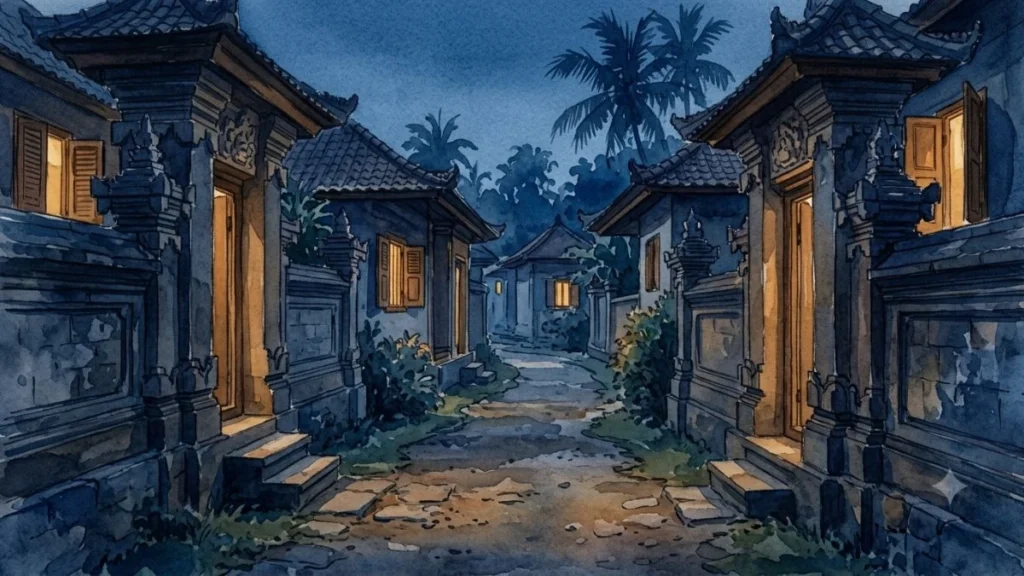
Once a year, an entire island turns off. Streets empty. Airports close. Lights stay dim after dark. No music plays, no one travels, and even the internet is voluntarily restricted in many areas. This isn’t an emergency. It’s Nyepi, Bali’s Day of Silence, and it may be the only major holiday in the world built entirely around the deliberate absence of activity rather than the presence of celebration.
What It Literally Means
Nyepi comes from the Balinese word sepi, meaning quiet or silent. It marks the Balinese Hindu New Year according to the Saka calendar, but unlike most New Year celebrations built around fireworks, parties, and noise, Nyepi is observed through near-total stillness. For a full 24 hours, practicing Hindus across Bali — and by local regulation, everyone else on the island too — observe catur brata penyepian, four restrictions: no fire or light (amati geni), no work (amati karya), no travel (amati lelungan), and no entertainment or indulgence (amati lelanguan).
The word itself, then, isn’t just describing an event. It’s describing an entire imposed atmosphere — a whole island instructed, for one day, to become as still and quiet as the word sepi implies.
Where It Comes From
Nyepi’s roots trace to Balinese Hindu cosmology and the Saka calendar system, which arrived in Bali via Hindu influence from the Indian subcontinent centuries ago and merged with local Balinese belief systems into a distinct religious tradition. The day is understood, in part, as a time to trick or discourage malevolent spirits — the idea being that if the island appears completely empty, dark, and lifeless, spirits passing through will find nothing to disturb and simply move on, believing Bali to be uninhabited.
Beyond the spiritual reasoning, Nyepi also functions as a structured reset: a full day of self-reflection, fasting, and meditation, intended to mark the new year with introspection rather than celebration. The evening before Nyepi is actually the loudest night of the Balinese calendar — communities parade enormous, elaborately built effigies called ogoh-ogoh, representing demonic spirits, through the streets with music, fire, and noise, before symbolically burning or discarding them. Nyepi’s silence is deliberately positioned as the dramatic opposite of that night, a stillness that only makes sense in contrast to the chaos immediately preceding it.
How It’s Actually Used Today
Nyepi is unusual among religious holidays in that its restrictions are enforced island-wide, not just among practicing Hindus. Bali’s Ngurah Rai International Airport closes entirely for the full 24 hours, one of the only civilian airports in the world to shut down completely, by law, once a year. Streets are patrolled by community wardens called pecalang, whose job is to ensure residents and tourists alike stay indoors, keep lights low, and avoid making noise or venturing outside unnecessarily.
Tourists in Bali during Nyepi are expected to remain inside their hotels for the duration, with most hotels dimming exterior lighting and pausing non-essential services. For many visitors, this is initially disorienting — an entire vacation day with no movement, no shopping, no sightseeing — but it’s also, for a fair number, one of the most memorable parts of visiting Bali: a rare, imposed pause that modern travel almost never otherwise allows.
For Balinese Hindus, the day itself varies in intensity by individual devotion — some spend it in complete meditation and fasting at home, others simply enjoy a quiet, screen-free day with family, treating the restrictions less as strict religious law and more as a welcomed, culturally sanctioned excuse to slow down entirely.
Why English Doesn’t Have This Word
English-speaking cultures have quiet holidays and religious fasting days, but nothing quite matches Nyepi’s specific structure: an entire day of enforced, island-wide silence and stillness, applied uniformly to residents and outsiders alike, positioned explicitly as a New Year ritual rather than a mourning or fasting observance. Most Western holidays intensify activity — travel, gathering, noise. Nyepi is built on the opposite principle: that a new year is better marked by disappearing for a day than by celebrating loudly into it.
There’s also no real English equivalent for a holiday enforced at a civic, infrastructural level — airport closures, street patrols, mandatory darkened windows — purely to preserve a spiritual and cultural atmosphere. Most “quiet” observances in English-speaking cultures remain personal or optional; Nyepi is public, structural, and binding for everyone present on the island regardless of belief.
The Universal Takeaway
Nyepi offers something most calendars quietly lack: a sanctioned, collective permission to stop entirely, not just slow down. Most modern New Year traditions add more stimulation — louder parties, bigger fireworks, longer nights. Nyepi does the opposite, treating a full stop as the more meaningful way to mark a new beginning.
There’s a quiet argument embedded in the ritual worth sitting with even outside Bali: that reflection requires actual absence of noise and motion to happen properly, not just a passing mention of “taking time to reflect” squeezed between other obligations. Nyepi doesn’t leave stillness optional. It builds an entire day, and an entire island’s infrastructure, around making sure it actually happens.
FAQ
Do tourists have to observe Nyepi too?
Yes. While tourists aren’t required to fast or meditate, they are required to stay indoors, keep noise and lighting to a minimum, and avoid travel for the full 24-hour period, enforced by local wardens.
Does the airport really close for Nyepi?
Yes, Bali’s international airport closes completely for the full duration of Nyepi, one of very few civilian airports worldwide to shut down entirely on a recurring annual basis.
What happens the night before Nyepi?
Communities hold the ogoh-ogoh parade, featuring large, elaborately constructed effigies representing evil spirits, paraded through the streets with music and fire before being symbolically discarded — a loud contrast to the silence that follows.
Is Nyepi only observed by Hindus?
The religious observance is specific to Balinese Hindus, but the practical restrictions — no lights, no travel, no noise — are enforced island-wide for all residents and visitors regardless of religion.
Why is silence important during Nyepi?
Traditionally, the stillness is meant to make the island appear uninhabited to passing spirits, encouraging them to move on, while also creating space for a full day of reflection and fasting to mark the new year.