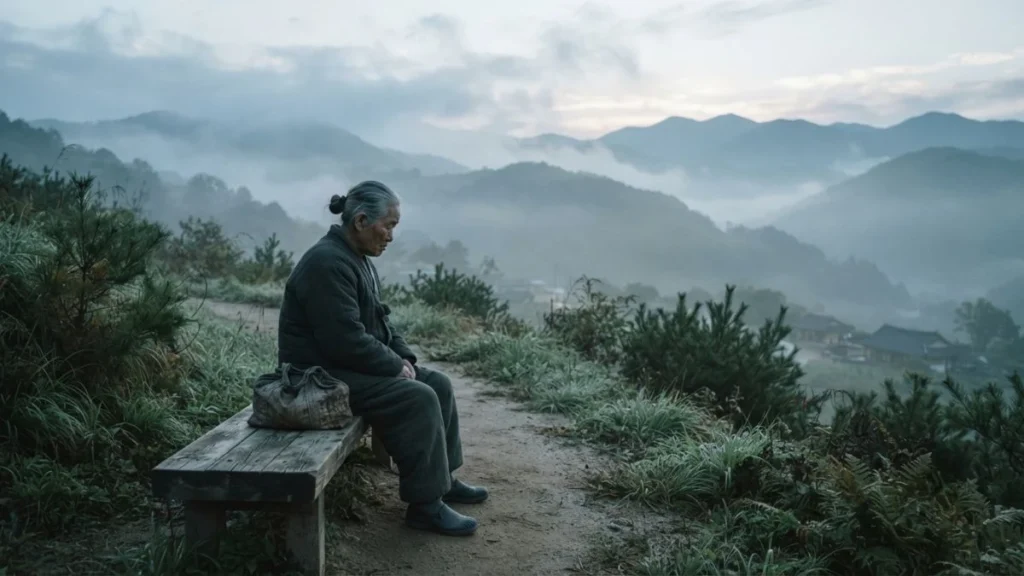
Some sorrow resolves. It peaks, it’s grieved, and eventually it loosens its grip. The Korean concept of han describes something different — a sorrow that settles in and stays, not as an open wound but as a kind of quiet, permanent resident inside a person or even an entire people. It’s one of the most written-about untranslatable words in the world, and also one of the most frequently oversimplified, so it’s worth slowing down and taking it seriously.
What It Literally Means
Han (한) is often translated loosely as “sorrow,” “grief,” or “resentment,” but nearly every serious attempt to explain it insists those words fall short. Han is better understood as a complex, layered emotional state combining deep sorrow, unresolved injustice, quiet resentment, and a kind of resigned endurance — all held together, often for a very long time, sometimes across an entire lifetime or even generations, rather than processed and released the way Western emotional frameworks typically expect grief to eventually resolve.
Crucially, han isn’t purely negative in the way English sorrow or resentment usually is. It’s frequently described as containing a strange, coexisting thread of hope or quiet resilience — a sadness carried alongside the will to keep going, rather than one that simply disables a person.
Where It Comes From
Han is deeply tied to Korea’s turbulent historical experience — centuries of invasion, occupation, division, and hardship, including Japanese colonial rule, the devastation of the Korean War, and the ongoing division of the peninsula. Scholars and Korean writers have long connected han to this accumulated national history of suffering endured without full resolution, suggesting the emotion isn’t just personal but partly collective, passed down and reinforced across generations who inherited both the historical memory and something of its emotional weight.
It’s worth noting that han’s status as a supposedly unique, near-mystical marker of Korean national character has itself been debated within Korea, with some scholars pushing back against overly essentialist framings that treat han as some singular, almost genetic Korean trait rather than a culturally reinforced emotional concept shaped by specific historical circumstances.
How It’s Used Today
Han appears constantly across Korean cultural expression — literature, film, and especially traditional music genres like pansori, a form of narrative singing frequently described as embodying han directly through its mournful, drawn-out vocal style. Contemporary Korean cinema and television dramas are also frequently discussed, both by Korean and international critics, as carrying threads of han in their frequent focus on endurance through hardship, unresolved loss, and quiet, long-suffering emotional restraint.
In everyday conversation, han is less commonly invoked as a casual descriptor than words like jayus or nongkrong might be in Indonesian daily speech — it functions more as a recognized cultural and artistic concept than an everyday feeling word tossed into casual conversation, closer to how English speakers might invoke “the American Dream” as a cultural touchstone rather than a phrase used constantly in small talk.
Why English Doesn’t Have This Word
English has grief, resentment, and melancholy, but treats each as a relatively distinct emotional category with an expected trajectory toward resolution — grief is processed, resentment is ideally released, melancholy passes. Han resists that entire framework by describing an emotional state understood as durable rather than temporary, and coexisting with resilience rather than opposed to it.
There’s also a collective dimension English struggles to capture. Western emotional vocabulary is heavily individual-focused — my grief, my resentment. Han carries a stronger sense of shared, inherited emotional experience, tied to a people’s collective historical memory rather than only individual circumstance, a framing English emotional vocabulary rarely accommodates comfortably.
Han and Jayus: Two Words, Two National Emotional Styles
It’s worth briefly setting han beside a very different untranslatable word explored elsewhere on this site: jayus, the Indonesian concept describing a joke so badly told it becomes funny anyway. The contrast is almost too clean to ignore. Jayus processes discomfort through communal laughter, turning a small social failure into shared joy in the moment. Han holds discomfort, often for a lifetime or longer, treating endurance itself as the response rather than resolution or release.
Neither approach is more emotionally sophisticated than the other — they simply reflect different cultural instincts about what to do with difficult feelings: dissolve them quickly through humor, or carry them forward as a kind of enduring, generationally inherited emotional inheritance.
The Universal Takeaway
Han offers a useful correction to an assumption baked deep into a lot of English-language emotional vocabulary: that all sorrow is meant to eventually resolve, and that carrying grief long-term signals something has gone wrong. Han suggests another possibility — that some sorrow, particularly sorrow tied to real historical injustice, isn’t meant to fully resolve, and that learning to carry it, rather than eliminate it, can itself be a form of resilience worth naming and respecting.
FAQ
Is han only about personal grief, or something bigger?
Both. Han operates at a personal emotional level but is also frequently discussed as a collective, historically rooted feeling connected to Korea’s shared national experience of hardship.
Is han considered a purely negative emotion?
Not entirely — most serious explanations of han emphasize a coexisting thread of resilience or quiet hope alongside the sorrow, distinguishing it from purely despairing emotional states.
Do Koreans use the word han in everyday conversation?
Less often as a casual descriptor than as a recognized cultural and artistic concept, frequently invoked in discussions of literature, film, and traditional music rather than typical small talk.
Is it accurate to call han a uniquely Korean national trait?
This framing has been debated by scholars, some of whom caution against treating han as an essentialist, near-mystical national characteristic rather than a culturally and historically shaped emotional concept.
What art forms are most associated with expressing han?
Pansori, a traditional form of Korean narrative singing, is among the most frequently cited, along with much of Korean literature and contemporary film and television.