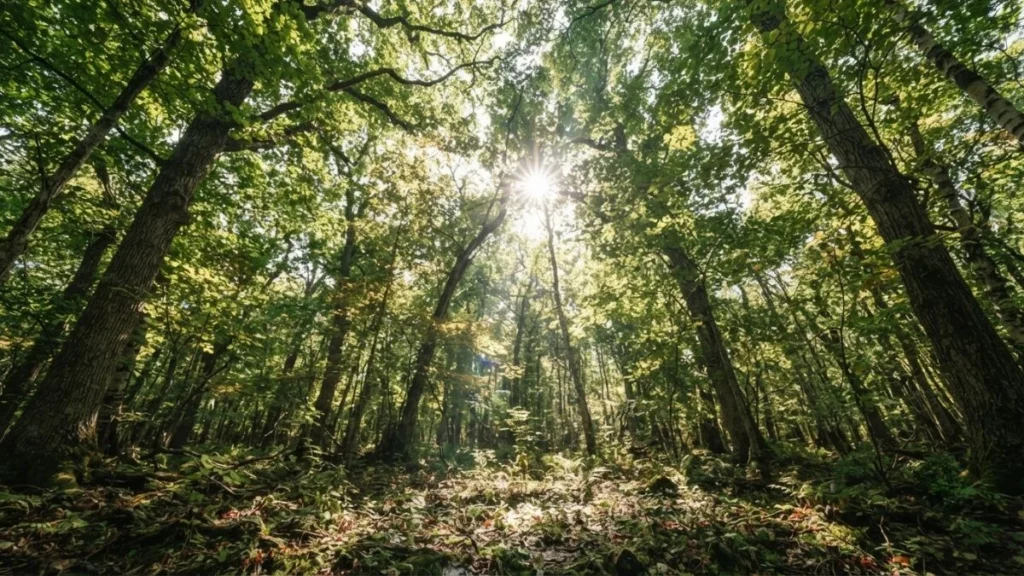
You’re walking under a canopy of trees and the light breaks apart above you — not a single ray, but dozens of small, shifting patches scattered across the ground, moving faintly with the leaves overhead. English has no single word for this. Japanese does. It’s called komorebi, and it belongs to a small, quietly beloved category of Japanese vocabulary built not around emotions or events, but around fleeting visual phenomena most languages never bothered to name.
What It Literally Means
Komorebi (木漏れ日) combines three kanji characters roughly meaning “tree,” “leak” or “escape,” and “sunlight” — together describing sunlight that filters, leaks, or escapes through the gaps between tree leaves. It’s not simply “dappled light” in the generic English sense; komorebi specifically evokes the particular quality of that light — soft, fragmented, gently shifting, filtered specifically through foliage rather than clouds, blinds, or any other obstruction.
Unlike many untranslatable words that describe an emotional or social state, komorebi describes a purely visual, almost meditative natural phenomenon — light and shadow interacting through a very specific kind of obstruction, at a very specific angle and softness.
Where It Comes From
Komorebi belongs to a broader pattern in Japanese vocabulary that assigns precise, poetic names to subtle natural phenomena — a linguistic tendency closely tied to Japan’s long literary and aesthetic tradition of close attention to nature, seasonal change, and transient beauty, concepts often discussed under broader ideas like mono no aware (a gentle awareness of the impermanence of things). While komorebi itself isn’t tied to a single historical text or origin point the way some cultural concepts are, its existence reflects that same deep, sustained cultural attentiveness to small, passing natural moments most other languages never felt compelled to name individually.
Japanese has several sibling words built on similarly specific natural observation — words for the sound of rain on leaves, the particular blue of a clear autumn sky, or the scent of rain hitting dry earth — situating komorebi within a much larger linguistic tradition of naming fleeting sensory experience with precision rather than treating it as background noise unworthy of its own vocabulary.
How It’s Used Today
Komorebi is used descriptively and often quite lyrically in everyday and literary Japanese alike — in poetry, in nature writing, in photography captions, and increasingly in casual conversation among people simply describing a pleasant moment in a park or forest. It carries a gentle, positive emotional undertone even though it’s technically describing a visual phenomenon rather than a feeling directly — noticing komorebi is generally treated as a small, quietly appreciated moment of natural beauty worth remarking on.
The word has also traveled well beyond Japan in recent years, becoming something of an internet-famous “untranslatable word,” frequently featured in language-lover compilations, tattoo inspiration lists, and aesthetic social media captions — often stripped of any deeper cultural context and reduced to a pretty-sounding word paired with a forest photo.
Why English Doesn’t Have This Word
English has “dappled light” and “sun-dappled,” which get reasonably close, but these phrases function as descriptive modifiers rather than a single, complete noun capturing the phenomenon as its own named thing. That distinction matters more than it might first appear: having a single dedicated word, rather than a two-word description, subtly elevates something from a background visual detail into a phenomenon worth naming and noticing in its own right.
This gap likely reflects a broader difference in poetic tradition rather than a simple vocabulary gap. Japanese literary and aesthetic culture has long placed unusual value on precisely naming small, transient natural phenomena — light, sound, scent — as worthy subjects in themselves, a tradition English nature writing engages with more through extended description than through dedicated, specific vocabulary.
The Universal Takeaway
Komorebi doesn’t just fill a vocabulary gap — it models a way of paying attention. Most people have stood under exactly this kind of light without ever having a word ready to notice it consciously, let alone name it to someone else in the moment. Having the word doesn’t just describe the phenomenon; it makes it more visible, more nameable, more likely to be genuinely noticed the next time it happens rather than passed through unremarked.
That’s arguably the most exportable idea inside komorebi: that giving something as fleeting and ordinary as filtered sunlight its own precise name is itself a small act of attention, and that attention, more than the word itself, is the real gift being offered.
FAQ
Is komorebi a commonly used word in everyday Japanese?
It’s understood and recognized broadly, and used descriptively in both casual and literary contexts, though it functions more as an evocative, slightly poetic word than an everyday utility term used constantly in ordinary speech.
Does komorebi only refer to sunlight in forests?
It most commonly describes sunlight filtering through tree leaves specifically, whether in a forest, a park, or even a single tree’s canopy, rather than dappled light from other sources like blinds or clouds.
Why has komorebi become popular online outside Japan?
It’s frequently featured in “untranslatable words” compilations and aesthetic content due to its evocative meaning and pleasant sound, though this popularity often strips away its deeper connection to Japanese nature-writing tradition.
Are there similar nature-specific words in Japanese?
Yes — Japanese has several words dedicated to precise natural phenomena, including specific terms for rain sounds, seasonal light qualities, and transient natural beauty, reflecting a broader linguistic and cultural tradition.
Is komorebi connected to any particular Japanese philosophy?
It’s often discussed alongside broader aesthetic concepts like mono no aware, a cultural sensitivity to the gentle impermanence of things, though komorebi itself is a standalone descriptive word rather than a formal philosophical term.