Ask an Indonesian what they’re doing tonight and you might hear: “nothing much, just nongkrong.” To an outsider, that sounds like doing nothing. In practice, it’s the opposite — it’s one of the most socially important things a person can do. English translates it as “hanging out,” but that translation quietly erases everything that makes the word worth having in the first place.
What It Literally Means
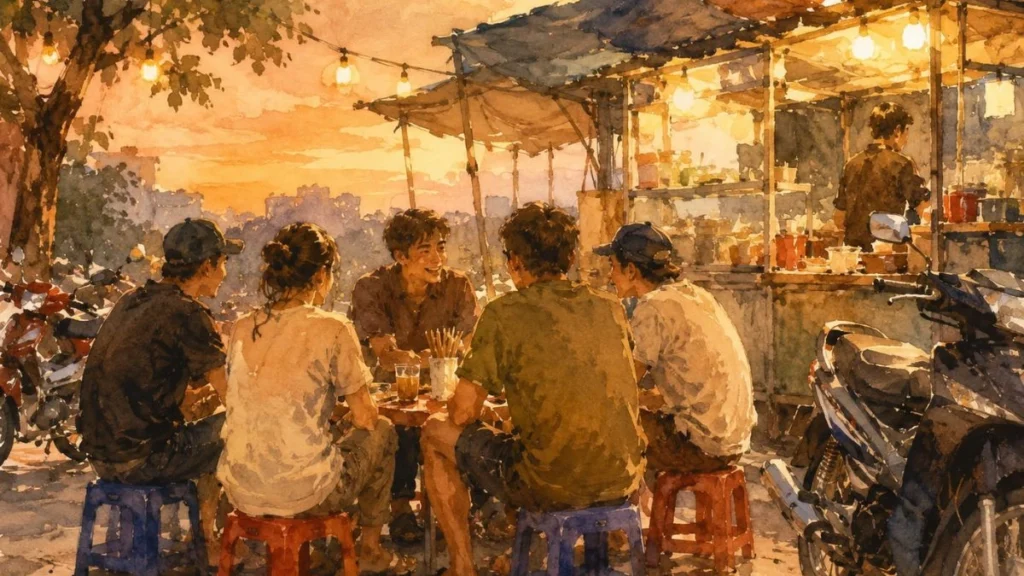
Nongkrong (pronounced “nong-krong”) is a verb that describes the act of sitting or squatting around casually with others, usually without a fixed agenda, often for hours, often at a roadside food stall, a porch, a parked motorbike, or the low curb outside a convenience store. Its root, jongkok, relates to squatting — a literal physical posture — but the word has stretched far beyond its origin to describe an entire social activity: unstructured, unhurried, communal time.
“Hanging out” is the reflexive English translation, and it’s not wrong so much as it’s flat. Hanging out in English can mean two people watching a movie in silence. Nongkrong implies talk, presence, and a kind of low-stakes togetherness that has its own unwritten rules.
Where It Comes From
Nongkrong’s roots are working-class and urban. It grew out of the culture of Indonesian street life — warungs (small food stalls), roadside coffee stands, and the informal public spaces that fill the gaps between people’s homes and their workplaces. Unlike a cafe culture built around paying for a seat and a drink, nongkrong culture was built around spaces that required no purchase, no reservation, and no real reason to be there beyond wanting to be around other people.
Over the decades it moved upward through Indonesian society rather than downward — from working-class street corners into student life, into the vocabulary of the urban middle class, and eventually into the marketing language of cafes themselves, many of which now explicitly brand their spaces as “tempat nongkrong” (a nongkrong spot) to attract customers who want exactly this atmosphere, just with better coffee.
How It’s Actually Used Today
Nongkrong is everywhere in Indonesian daily life, and its meaning flexes depending on who’s doing it and where. Teenagers nongkrong outside school gates after class, in no particular hurry to go home. Office workers nongkrong at a warung after work, decompressing before facing traffic. Entire neighborhoods have informal nongkrong spots — a specific curb, a specific stall — that function as unofficial community hubs, where news, gossip, and local problems get discussed as much as jokes and small talk.
Importantly, nongkrong isn’t just downtime squeezed between obligations — for many Indonesians, it is the obligation, in a social sense. Skipping a regular nongkrong session with friends can register as a small social absence, the same way missing a standing coffee date might in other cultures, except nongkrong tends to have lower stakes and looser scheduling, which is part of its appeal. You don’t need to be invited. You just need to know where people usually are.
There’s also an economic logic quietly built into nongkrong that’s easy to miss from the outside. A single glass of sweet tea or a small pack of fried snacks can be the entire cost of an evening’s socializing, split or not split among a group who might stay for two or three hours. This is part of why nongkrong culture has thrived in a country where formal “third spaces” like Western-style cafes were, for a long time, out of reach for a large share of the population. The warung owner, in turn, tolerates — even welcomes — customers who linger for hours over one drink, because a loyal group of regulars who nongkrong there every evening is worth more over time than a single fast-paying customer. It’s a quiet, mutually understood economy of presence rather than consumption.
Why English Doesn’t Have This Word
English has “hanging out,” “chilling,” “shooting the breeze” — all useful, none quite right. The gap isn’t vocabulary, it’s structure. Most English equivalents describe an activity happening despite having nothing to do. Nongkrong describes an activity that is the thing to do — casual presence as a legitimate, standalone social event, not a placeholder for something more “productive.”
There’s also a spatial dimension English struggles with. Nongkrong is deeply tied to specific, often humble physical settings — the curb, the stall, the low plastic stool — in a way that “hanging out” isn’t tied to any particular kind of place. Losing that specificity in translation loses something real: nongkrong isn’t just an activity, it’s a whole aesthetic of informal public space that Indonesian cities are built around in ways many Western urban environments simply aren’t.
The Universal Takeaway
Strip away the specific setting, and nongkrong points to something most people quietly crave: unstructured time with other people that doesn’t need to justify itself. Modern life, in almost every culture, is full of scheduled social contact — the coffee catch-up, the planned dinner, the calendar invite for “hanging out.” Nongkrong is a reminder that some of the most valuable social time is the kind nobody had to plan.
Giving that a name is useful precisely because it pushes back against the instinct to treat unstructured time as wasted time. Once you have the word, it becomes easier to notice — and maybe even protect — those pockets of low-stakes togetherness in your own life, wherever your version of the curb and the warung happens to be.
FAQ
Is nongkrong the same as “hanging out”?
Closely related but not identical. “Hanging out” is a general catch-all in English, while nongkrong carries specific connotations of casual, often low-cost public settings and open-ended time with no fixed plan.
Do you need to be invited to nongkrong?
Usually not. Nongkrong spots tend to be informal and semi-public — a regular stall or curb — so people often just show up, knowing others from their circle are likely to be there too.
Is nongkrong only for young people?
No. While it’s strongly associated with teenagers and young adults, nongkrong culture spans generations — older men gathering at a coffee stall in the evening are engaging in the same basic social ritual.
Can nongkrong happen in a cafe?
Yes, and increasingly does. Many modern Indonesian cafes market themselves specifically as nongkrong-friendly spaces, offering cheap coffee and long stays rather than the fast-turnover model common elsewhere.
Is there a time limit to nongkrong?
Not formally, and that’s part of the point — sessions can stretch for hours without anyone treating it as unusual, since the openendedness is part of what makes it nongkrong rather than a scheduled meeting.