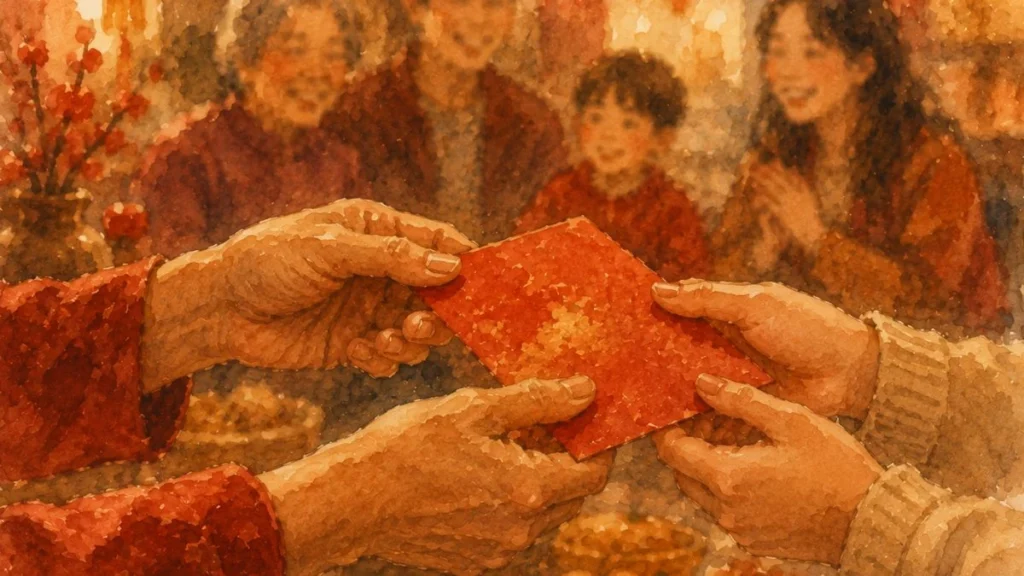
A red envelope changes hands at a family gathering. No one announces an amount. No one asks how much is inside. And yet everyone present — giver and receiver alike — is running a silent calculation shaped by age, relationship, and unspoken tradition. This is angpao, and almost none of its actual rules are ever explained to you directly. You’re just expected to absorb them by watching, year after year, until you understand it without anyone ever spelling it out.
What It Literally Means
Angpao (also spelled angpau, from Hokkien ang pao, literally “red packet”) refers to the red envelope containing money given as a gift, most commonly during Chinese New Year, but also at weddings, births, and other celebratory occasions within Indonesia’s ethnic Chinese community and beyond. The red color itself carries meaning — in Chinese tradition, red symbolizes luck, vitality, and warding off misfortune, which is why the money is never simply handed over loose or in a plain envelope.
The word has since spread well past its original community. Many non-Chinese Indonesians now use angpao loosely to describe any cash gift presented in an envelope, at weddings especially, even when there’s no Chinese cultural context involved at all — a sign of how thoroughly the practice, and the word for it, has been absorbed into broader Indonesian custom.
Where It Comes From
Angpao traditions arrived in Indonesia along with generations of Chinese immigration, particularly from Hokkien and Cantonese-speaking regions, and adapted over time within the local Chinese-Indonesian community. Like many customs carried across a diaspora, it evolved distinct local features that don’t perfectly mirror how it’s practiced in mainland China, Hong Kong, Taiwan, or Singapore — amounts, timing, and specific occasions for giving all shifted slightly to fit Indonesian social life.
The practice survived, and in some periods even had to survive quietly, through decades when Chinese-Indonesian cultural expression faced significant restriction. Its resilience and eventual public resurgence is itself part of the story — angpao today is celebrated openly and visibly, in malls, offices, and TV specials during Chinese New Year, in a way that would have been unthinkable a few decades earlier.
How It’s Actually Used Today
The core rule, learned entirely through observation rather than instruction, is that angpao flows from married to unmarried, and from older to younger. A married adult gives to unmarried relatives regardless of the unmarried person’s age — meaning a 35-year-old unmarried nephew may still receive angpao from a 30-year-old married aunt, an arrangement that can feel faintly awkward but is rarely questioned openly.
The amount inside is governed by an equally unspoken hierarchy: closer relatives generally give more than distant ones, and certain numbers are deliberately avoided or favored. Numbers containing 8 are considered auspicious (the word for eight sounds similar to the word for prosperity in Chinese), while 4 is typically avoided (it sounds close to the word for death). Amounts are also almost always in even numbers, since odd-numbered cash gifts are traditionally associated with funerals rather than celebrations.
Perhaps the least-discussed rule is the one around dignity: a thin, disappointing angpao is a known source of quiet embarrassment, both for the giver who couldn’t afford more and the receiver who notices, but virtually nobody comments on this out loud. The envelope is opened later, privately, precisely so the amount doesn’t become a topic of visible comparison in the room.
Why English Doesn’t Have This Word
English-speaking gift culture has cash gifts, certainly, but rarely with this dense a layer of unstated hierarchy and numerology attached to a single, ritualized object. “Cash gift” or “money envelope” describes the mechanics but says nothing about who gives to whom, why certain numbers matter, or why the entire system runs on silence rather than explicit rules.
That silence is itself the hardest part to translate. In much of Western gift-giving culture, there’s more room for direct conversation about gifts — “what should I get them,” “here’s roughly what I spent.” Angpao operates almost entirely through inherited, undiscussed knowledge, transmitted by watching relatives do it correctly for years rather than by anyone sitting you down and explaining the rules. English doesn’t just lack the word; it lacks a cultural container for a gift-giving system built entirely on shared, unspoken understanding.
The Universal Takeaway
Every culture has some version of a gift whose “correct” execution matters more than the gift-giver realizes, and where the real rules are absorbed rather than taught — think of tipping in the United States, where amounts, occasions, and exceptions are famously confusing to outsiders and rarely explained clearly even to locals. Angpao is a particularly vivid version of that same pattern: a practice so socially loaded that explaining it out loud would almost undercut its point.
What angpao ultimately reveals is how much of any culture’s etiquette isn’t written down anywhere, but survives instead through generations of quiet observation — and how much anxiety and meaning can live inside a small red envelope that nobody ever discusses directly, even as everyone silently understands exactly what’s expected of them.
FAQ
How much money should be in an angpao?
There’s no fixed rule, but amounts are typically even numbers, often avoiding 4 (associated with death) and favoring 8 (associated with prosperity). The amount usually scales with closeness of relationship and the giver’s financial means.
Who is expected to give angpao?
Generally, married individuals give to unmarried relatives, regardless of the unmarried person’s age, and older generations give to younger ones. Parents and grandparents are typically the most consistent givers.
Is angpao only for Chinese New Year?
No, though that’s its most prominent occasion. Angpao-style envelopes are also common at weddings, births, and other celebrations, both within Chinese-Indonesian tradition and, increasingly, in broader Indonesian wedding customs.
Is it rude to open an angpao in front of the giver?
Traditionally, yes — angpao is typically opened later, in private, specifically to avoid any visible comparison of amounts between recipients in the same room.
Do non-Chinese Indonesians use angpao?
Increasingly yes, particularly the term itself, which is now used loosely by many Indonesians to describe any cash gift given in an envelope, especially at weddings, regardless of ethnic or religious background.