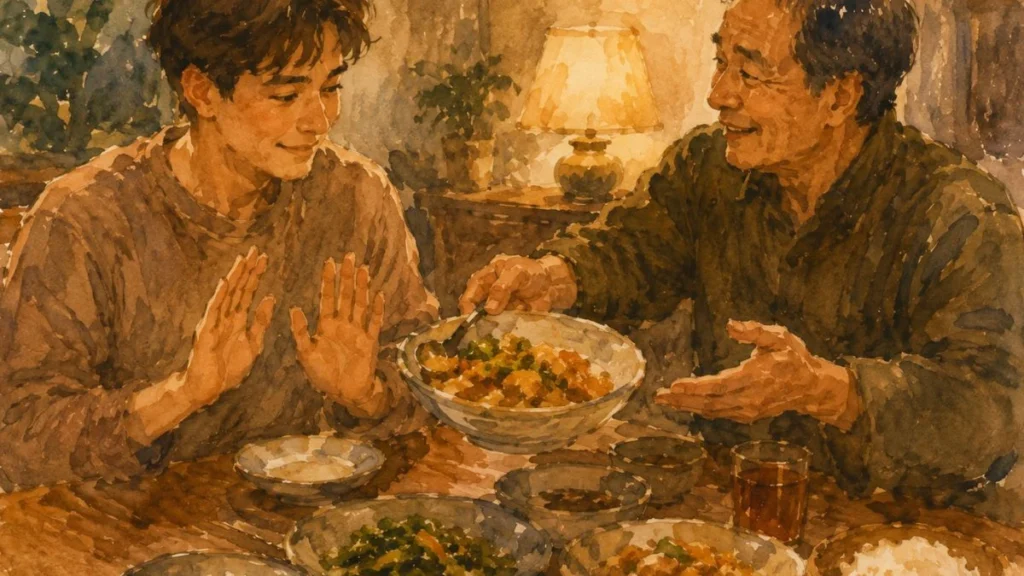
You’re offered a second helping of food at someone’s house. You don’t want to seem greedy, but you also don’t want to offend your host by refusing, and there’s a faint discomfort in even having to make the choice. English speakers usually reach for “shy” or “awkward” to describe that feeling. Indonesians have a more precise word, and once you understand it, you’ll notice you’ve been misusing “shy” your whole life to describe something it was never built to hold. The word is sungkan.
What It Literally Means
Sungkan (pronounced “SOONG-kahn”) describes a specific kind of reluctance — the discomfort of acting on your own wants or needs when doing so might inconvenience, embarrass, or impose on someone else, especially someone you respect or feel indebted to. It’s not shyness, which is about self-consciousness in front of others. It’s not awkwardness, which is about a situation feeling socially unresolved. Sungkan is about restraint out of consideration — holding yourself back not because you’re nervous, but because acting would put someone else in an uncomfortable position.
If shy is “I don’t want attention on me,” sungkan is closer to “I don’t want to be a burden on you.” The center of gravity is completely different. Shy points inward, toward your own comfort. Sungkan points outward, toward someone else’s.
Where It Comes From
Sungkan has deep roots in Javanese social hierarchy and etiquette, where relationships are frequently organized around relative status, age, and closeness — concepts that show up throughout Javanese vocabulary in ways that don’t map neatly onto more horizontally structured Western social norms. The word carries some of that same DNA: it’s most intensely felt toward people who are older, more senior, more respected, or simply more established in a relationship than you are.
It entered broader Indonesian usage from Javanese, following a well-worn pattern where the country’s most populous ethnic group has quietly shaped national vocabulary far beyond Java’s own borders. Today sungkan is used across Indonesia regardless of ethnic background, though the feeling it names is arguably still most intensely, most reflexively felt within Javanese social contexts, where the instinct to defer and avoid imposing runs especially deep.
How It’s Actually Used Today
Sungkan shows up constantly in situations involving a power or seniority gap: an employee feeling sungkan to ask their boss for a day off, a guest feeling sungkan to ask a host for a glass of water, a younger relative feeling sungkan to disagree with an older one at a family gathering. In each case, the person isn’t scared, and the situation isn’t necessarily tense — they simply feel it would be improper, or a little selfish, to act on their own preference when someone else’s comfort or authority is in the frame.
It also functions as a kind of social lubricant when explicitly acknowledged. Saying “jangan sungkan” (“don’t feel sungkan,” or more loosely, “don’t hold back”) is an extremely common phrase, used by hosts to guests, bosses to employees, and elders to younger relatives, as an explicit invitation to set the restraint aside. The fact that this phrase needs to exist — and gets used so often — tells you how automatic the feeling of sungkan usually is. It’s assumed by default; permission has to be actively granted to override it.
Notably, sungkan isn’t always considered a problem to solve. It’s frequently framed as a marker of good manners rather than a social anxiety to overcome. Someone who feels no sungkan at all — who freely imposes on others without a second thought — can come across as inconsiderate rather than confident.
Why English Doesn’t Have This Word
English collapses several distinct social-emotional states into a small handful of words — shy, awkward, embarrassed, self-conscious — because English-speaking social norms tend to center the individual’s internal experience as the primary thing worth naming. Sungkan resists that collapse because it isn’t primarily about how you feel; it’s about the relational calculation between your needs and someone else’s comfort.
This is also why direct translation attempts routinely fail. “I felt shy to ask” implies nervousness about self-exposure. “I felt awkward asking” implies the situation itself was socially unresolved or tense. Neither captures the actual internal logic of sungkan, which is closer to: “I could ask, nothing bad would necessarily happen, but doing so would place a small weight on you that I’d rather carry myself.” That’s a moral and relational judgment, not a description of nervousness — a distinction English’s existing vocabulary simply wasn’t built to make.
The Universal Takeaway
Even without a word for it, most people have felt some version of sungkan — the hesitation to ask a favor of someone you admire, the instinct to say “no, I’m fine” when you’re actually not, the discomfort of potentially inconveniencing someone whose goodwill matters to you. What sungkan offers isn’t a foreign emotion, but a sharper lens on a familiar one: the difference between holding back because of your own fear, and holding back out of genuine consideration for someone else.
Naming that distinction matters, because the two require very different responses. Shyness might call for more confidence. Sungkan might call for an explicit “don’t feel sungkan” from the other person — a reminder that your comfort matters too, not just theirs.
FAQ
Is sungkan the same as being shy?
No. Shyness is about self-consciousness or nervousness around others. Sungkan is about reluctance to act because doing so might inconvenience or impose on someone else, particularly someone respected or senior.
Is sungkan a positive or negative trait?
It’s generally viewed positively, as a sign of good manners and consideration for others. It only becomes a problem when it prevents someone from expressing genuine needs, especially in situations where speaking up would actually be welcome.
What does “jangan sungkan” mean?
It translates loosely to “don’t hold back” or “don’t feel like you’re imposing.” It’s a common phrase used to explicitly release someone from the social restraint that sungkan usually imposes.
Is sungkan specific to Javanese culture?
Its roots are Javanese, but the word and the feeling it describes are used and understood across Indonesia today, even among people from ethnic backgrounds with different social etiquette traditions.
How is sungkan different from being polite?
Politeness is a general social behavior. Sungkan is a specific internal feeling — the discomfort behind a polite action, not the action itself. You can be polite without feeling sungkan, and feel sungkan while still managing to ask for what you need.