Boun Bang Fai rocket festival is one of Laos’ most distinctive traditional celebrations, held each year before the rice planting season to welcome the rains. Villages spend weeks building homemade rockets, some several meters long, before launching them in spirited community competitions. A rocket that soars high is believed to bring honor and good fortune, while one that fails to launch often earns its builders playful public teasing. More than a spectacle, Boun Bang Fai combines agricultural tradition, community celebration, and centuries-old beliefs about the coming rainy season.
The Ritual Itself
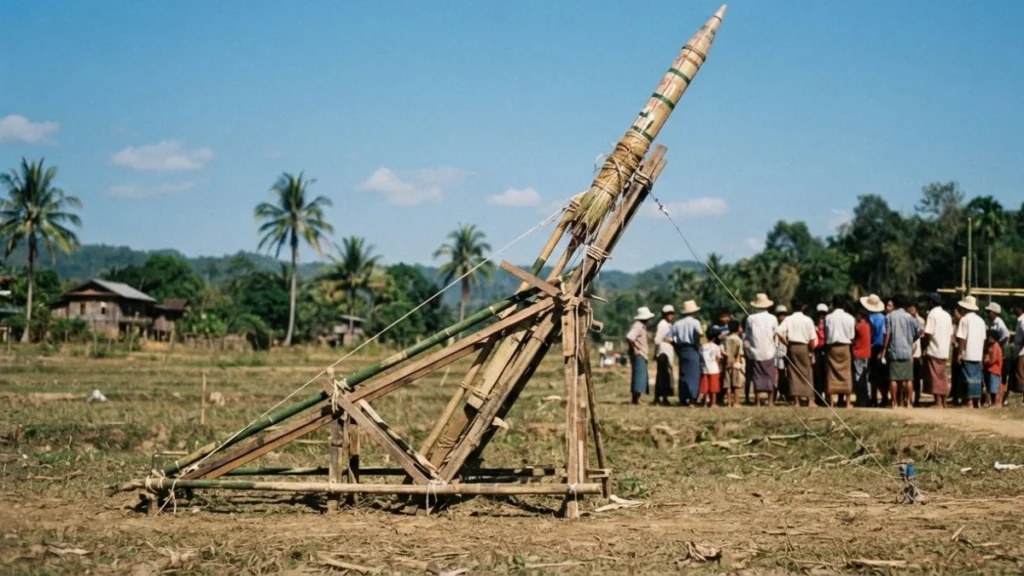
Boun Bang Fai typically takes place in May or June, timed deliberately to precede the rice planting season, and centers on the launching of homemade bamboo and PVC rockets (bang fai) built by village teams, temples, or community groups, often over weeks or months of careful preparation. The rockets vary considerably in size and sophistication, from smaller amateur builds to elaborate, professionally decorated rockets that can travel remarkable distances into the sky, launched from purpose-built wooden launch ramps amid enthusiastic crowds.
The celebration carries genuine competitive stakes alongside its ritual purpose: rockets that fly successfully and reach impressive heights bring pride and honor to their builders and village, while rockets that fail to launch, explode prematurely, or perform poorly traditionally result in the builders being playfully thrown into nearby mud as good-natured punishment — a lighthearted but very real component of the day’s festivities.
Where It Comes From
The festival’s origins connect to animist rain-invoking beliefs predating widespread Buddhist influence in Laos, rooted in the practical agricultural concern of ensuring adequate rainfall for the upcoming rice-growing season in a historically agrarian society deeply dependent on seasonal monsoon patterns. The loud, skyward rocket launches were traditionally understood as a direct appeal or provocation to the rain deities or spirits believed to control seasonal precipitation, a request delivered through spectacle and noise rather than quiet prayer alone.
Over time, Boun Bang Fai absorbed Buddhist elements as well, with temples frequently playing an organizing role in contemporary celebrations, blending the older animist rain-ritual purpose with more recent religious and community structures — a layering pattern consistent with similar blended animist-Buddhist and animist-Islamic traditions found across mainland and maritime Southeast Asia more broadly.
Modern Practice
Boun Bang Fai remains a major, widely celebrated festival across Laos today, with particularly large and well-known celebrations in Vientiane and various provincial centers drawing significant crowds, alongside countless smaller village-level celebrations throughout the country’s rural areas. The festival has also become an important part of Lao cultural identity in Isan, the Lao-influenced northeastern region of Thailand, where communities with strong Lao cultural and linguistic ties observe parallel rocket festival celebrations, sometimes drawing even larger crowds than events within Laos itself.
The celebration typically extends beyond the rocket launches themselves into a broader community festival atmosphere, including traditional music, dance performances, and processions, with the rocket competition serving as the day’s central, most anticipated event rather than the entirety of the celebration. Safety around the homemade rockets, given their genuine explosive power and occasional malfunction, has become an increasing point of organizational attention in more formal, larger-scale contemporary celebrations, even as the tradition’s fundamental spirit and format remain consistent with its historical roots.
What Outsiders Often Get Wrong
International coverage sometimes frames Boun Bang Fai primarily as a quirky, spectacle-driven curiosity — homemade fireworks and mud-throwing — without engaging with its underlying agricultural and spiritual purpose as a rain-invoking ritual tied to genuine seasonal survival concerns in traditional Lao farming communities, treating what’s fundamentally a serious, purposeful tradition as purely playful novelty.
There’s also a tendency to overlook the festival’s significant presence and cultural weight beyond Laos’ own borders, particularly within Thailand’s Isan region, where Lao cultural influence remains strong and Boun Bang Fai celebrations carry comparable, sometimes even greater, community significance and scale.
FAQ
What is the purpose of launching rockets during Boun Bang Fai?
Traditionally, the rockets are understood as a request or appeal to rain deities or spirits to bring adequate rainfall for the upcoming rice planting season, rooted in the region’s agricultural dependence on seasonal monsoons.
Why are unsuccessful rocket builders thrown in mud?
This is a lighthearted, traditional form of good-natured punishment or teasing for rockets that fail to launch properly, adding a playful competitive element to the day’s festivities.
When does Boun Bang Fai typically take place?
The festival is usually held in May or June, timed deliberately before the start of the rice planting season.
Is Boun Bang Fai only celebrated in Laos?
No, it’s also widely celebrated in Thailand’s Isan region, which has strong Lao cultural and linguistic ties, sometimes drawing celebrations of comparable or even greater scale than those within Laos itself.
Are the rockets dangerous?
Yes, they carry genuine explosive power, and safety has become an increasing organizational focus in larger, more formal contemporary celebrations, even as the tradition’s core format remains consistent with its historical roots.