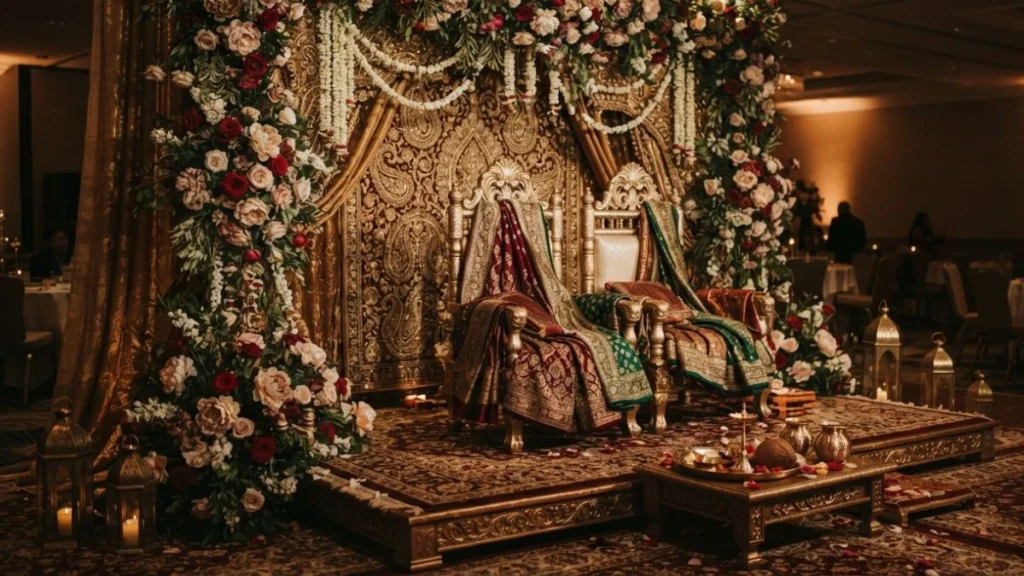
Bersanding Malay wedding is a traditional ceremony in which the bride and groom are honored as symbolic royalty for a day. At the heart of the celebration sits an elevated, ornately decorated dais where the couple, dressed in matching royal-style attire, receives blessings from family and guests. More than a beautiful photo opportunity, the bersanding ceremony represents dignity, respect, and the community’s recognition of a new stage in the couple’s life together.
What It Literally Means
Bersanding translates roughly to “sitting together” or “sitting in state,” referring specifically to the ceremony in which the bride and groom are formally seated together on an elevated, decorated platform (pelamin) in front of assembled family and guests, typically dressed in matching, elaborately embroidered traditional royal-style clothing, complete with ceremonial accessories that deliberately evoke Malay royal regalia.
The ceremony’s symbolic core is the raja sehari concept — literally “king [and queen] for a day” — treating the couple as temporary royalty for the duration of the ceremony, a formal, structured elevation rather than a casual figure of speech.
Where It Comes From
Bersanding’s roots trace to the Malay royal courts, where the practice of elevating a wedding couple to symbolic royal status developed within a broader courtly and adat-influenced framework of ceremony and social hierarchy — the same customary law tradition explored elsewhere on this site, which historically governed not just legal matters but structured ceremonial life across Malay society, including marriage. Over time, the practice spread beyond royal and aristocratic circles into broader Malay wedding tradition, eventually becoming a standard, expected element of formal Malay wedding celebrations across social classes.
The symbolic elevation carries genuine cultural weight beyond decoration: the wedding day is understood, at least symbolically, as the most significant, honored day in the couple’s life together, and the raja sehari framing formalizes that significance through a temporary, ceremonially structured status elevation rather than leaving it as an unspoken sentiment.
How It’s Practiced Today
Modern bersanding remains a near-universal feature of traditional Malay weddings, typically held after the formal religious solemnization (akad nikah), functioning as the more public, celebratory portion of the wedding proceedings. The couple’s attire — often matching in color and elaborately embroidered, sometimes incorporating songket, a traditional handwoven fabric historically associated with Malay royalty — is chosen specifically to visually reinforce the ceremony’s royal symbolism.
During bersanding, guests traditionally approach the dais to offer blessings, often accompanied by a ceremonial sprinkling of yellow rice (bertih or beras kunyit) and rosewater over the couple’s hands, gestures understood as blessings for prosperity and happiness in the marriage. The ceremony typically takes place at a kenduri kahwin, the broader wedding feast and celebration attended by extended family, friends, and community members, often numbering in the hundreds for larger Malay weddings.
Modern variations have introduced updated staging, lighting, and photography-driven presentation to the ceremony, though the core symbolic structure — the elevated seating, matching royal-style attire, and formal blessing procession — remains largely consistent with long-standing tradition even as specific decorative styles evolve with contemporary trends.
What Outsiders Often Get Wrong
Visitors sometimes assume bersanding is purely a photogenic staging moment for wedding photography, missing its deeper symbolic connection to raja sehari status and its roots in Malay royal and adat tradition, treating what’s actually a structurally significant ceremonial element as simply decorative wedding aesthetic.
There’s also a tendency to conflate bersanding with the wedding as a whole, when it’s specifically one distinct ceremonial component, typically following the separate, religiously significant akad nikah solemnization — the two events carry different purposes and levels of religious versus cultural significance within the broader wedding celebration.
FAQ
What does “raja sehari” mean?
It translates to “king [and queen] for a day,” describing the symbolic elevation of the bride and groom to temporary royal-like status during the bersanding ceremony.
Is bersanding a religious ceremony?
No, it’s a cultural and ceremonial tradition rooted in Malay adat and royal court tradition, distinct from the akad nikah, which is the religiously significant marriage solemnization.
What is worn during bersanding?
Couples typically wear elaborate, often matching traditional attire, sometimes incorporating songket, a handwoven fabric historically associated with Malay royalty, along with ceremonial accessories evoking royal regalia.
What is the significance of sprinkling rice and rosewater during the ceremony?
This gesture, performed by guests approaching the dais, is a traditional blessing for prosperity and happiness offered to the newly elevated “royal” couple.
Is bersanding practiced the same way across all Malay communities?
The core structure is broadly consistent, though specific decorative styles, attire details, and regional customs can vary somewhat across different Malay communities and regions.