A neighbor moves into a new house. A baby turns one week old. Someone recovers from a long illness. In much of Java, each of these moments is marked the same way: a shared meal, a short prayer, and a room full of neighbors who may not be close friends but who show up anyway. This ritual is slametan, and it may be the single most quietly recurring tradition in Javanese life — so routine that many who grow up with it never stop to notice how unusual it would look to an outsider.
What It Literally Means
Slametan comes from the Javanese and Indonesian word selamat, meaning safe, well, or blessed — the same root used in everyday greetings like selamat pagi (good morning) or selamat ulang tahun (happy birthday). A slametan, then, is essentially a ritual of safety and blessing: a communal gathering, almost always centered around a shared meal, held to mark a transition, give thanks, ask for protection, or simply restore social and spiritual balance around an event.
Unlike a festival with a fixed date, slametan is occasion-triggered rather than calendar-triggered. It can be held for a birth, a death, a house move, a pregnancy milestone, a harvest, a recovery from illness, or the anniversary of a death — the ritual’s exact form flexes to whatever the occasion demands, but the underlying structure of shared food and shared presence stays remarkably constant.
Where It Comes From
Slametan’s roots run deep into Java’s layered religious history, blending pre-Islamic animist and Hindu-Buddhist practices with Islamic prayer, in a syncretic mix that anthropologists have studied for decades as a defining feature of what’s often called kejawen — traditional Javanese spirituality. The ritual predates the widespread arrival of Islam on Java and was gradually absorbed into Islamic practice rather than replaced by it, which is why a modern slametan typically includes Islamic prayers (doa) even as its underlying logic — appeasing unseen forces, restoring communal balance — traces back much further.
This layering is part of why slametan has occasionally drawn tension between more orthodox religious interpretation and traditional practice, with some viewing it as a legitimate expression of local Islamic culture and others viewing its animist undertones with more caution. In practice, across most of Java, it remains a widely accepted, largely uncontroversial part of everyday social life, performed by families across a range of religious observance levels.
How It’s Actually Used Today
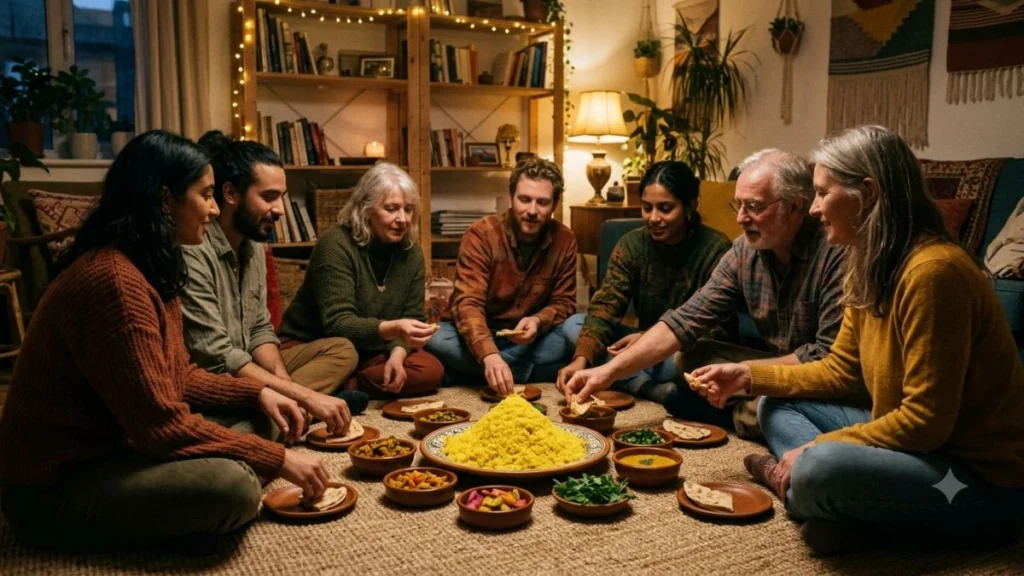
A typical slametan gathers neighbors, relatives, and sometimes a local religious figure, usually in the evening, in or around the host’s home. Food is central and highly symbolic — the centerpiece is often tumpeng, a cone-shaped mound of yellow rice surrounded by side dishes, though the exact menu varies by region and occasion. A short prayer is recited, sometimes led by an imam or elder, giving thanks or requesting protection relevant to the occasion. Afterward, the food is eaten together, and guests often take a portion home wrapped for family members who couldn’t attend.
Crucially, attendance isn’t really about friendship — it’s about presence. Neighbors who barely interact day to day are still expected to show up to each other’s slametan, because the ritual functions as much as a social bonding mechanism as a spiritual one. Not attending a close neighbor’s slametan without good reason can register as a small social slight, similar in spirit to the social weight carried by gotong royong participation — showing up is itself the point, regardless of how close the relationship actually is.
Modern life has thinned some slametan practices in dense urban apartment living, where neighbors may not know each other well enough for the ritual to make sense in its traditional form. But in villages and many suburban neighborhoods across Java, it remains a living, frequently observed tradition rather than a historical curiosity.
Why English Doesn’t Have This Word
English-speaking cultures certainly mark transitions with gatherings — housewarmings, wakes, baby showers — but almost always as separate, occasion-specific rituals with their own distinct names and formats. Slametan is unusual in functioning as one flexible ritual template applied across an enormous range of life events, unified by the same underlying logic of shared food, prayer, and neighborly presence regardless of what’s actually being marked.
There’s also no real English equivalent for the specific social obligation slametan carries — the expectation that neighbors attend regardless of closeness, purely because communal presence itself is understood as the ritual’s real function. Western equivalents like a housewarming party are typically framed as optional and friendship-based; slametan operates on a more binding, community-wide logic that doesn’t map cleanly onto “you’re invited if we’re close.”
The Universal Takeaway
Strip away the specific prayers and the tumpeng rice cone, and slametan points to something many cultures quietly recognize but rarely formalize as clearly: that big life transitions are steadied not just by private reflection, but by a room full of people showing up, eating together, and briefly making a private moment collectively witnessed. Slametan doesn’t leave that instinct to chance or individual initiative — it built an entire, repeatable social structure around it.
That’s arguably the most exportable idea inside the word: the notion that community presence during transition is itself a kind of protection, worth ritualizing rather than leaving to whoever happens to think of it.
FAQ
Is slametan a religious ritual?
It combines elements of Islamic prayer with older animist and Hindu-Buddhist traditions, making it syncretic rather than purely religious in the formal sense. Views on it vary among more orthodox and more traditional Javanese Muslims.
What occasions call for a slametan?
Almost any significant life transition — births, deaths, house moves, pregnancy milestones, recovery from illness, and harvests are among the most common triggers.
Do you need to be invited to attend a slametan?
Typically yes, though invitations among neighbors are often informal and expected rather than something one might decline, given the social weight placed on attendance.
What food is usually served at a slametan?
Tumpeng, a cone-shaped mound of seasoned yellow rice with assorted side dishes, is the most iconic centerpiece, though the specific menu varies by region and occasion.
Is slametan still practiced in Indonesian cities?
Yes, though less consistently than in villages, where close-knit neighborhoods make the tradition’s social logic easier to sustain than in anonymous urban apartment living.